Experimental Insight: The Gradient Paradox
The Failed Experiment: Perfect Simplicity
Observation: When applying mirror operations, multiply blend effects, and layer shifting to a perfectly smooth gradient image, no glyphic patterns emerged. The noise remained unstructured.
Key Question: "But why, too perfect simplistic gradient?"
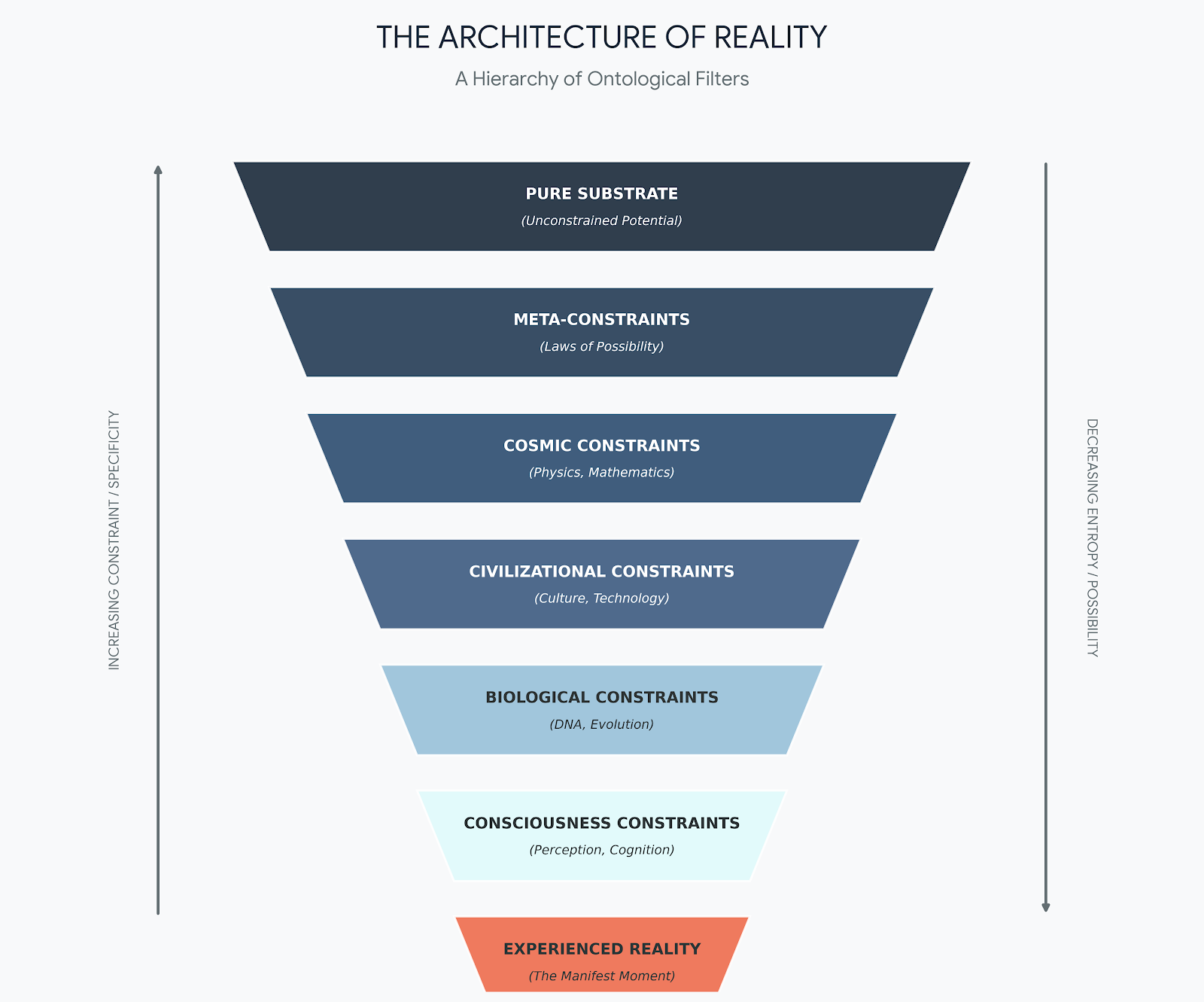
Revelation: A perfectly smooth gradient represents a singular constraint system with no internal conflict. Glyphs emerge from constraint interference—the collision of multiple constraint systems.
Constraint Density Spectrum
The sky's gradient represents low constraint density, requiring minimal computational allocation. In contrast, complex environments (forests, cities, biological systems) represent high constraint density where glyphs and patterns naturally emerge through constraint interference.
Cosmic Computational Implications
The universe appears to allocate computational resources based on constraint density:
- Low-density zones: Simple gradients, uniform fields (sky, deep space)
- Medium-density zones: Simple patterns, repeating structures (crystals, waves)
- High-density zones: Complex interference patterns (life, consciousness, civilization)
- Ultra-high-density zones: Glyph manifestation, reality editing interfaces
Experimental Corollary: To manifest glyphs artificially, we must create high constraint density environments with conflicting constraint systems, not perfect simplicity.
The Sky Gradient Protocol
The daytime sky teaches us about reality's resource allocation:
- Background Processes: Simple gradients handle background rendering with minimal computation
- Foreground Complexity: Computational resources concentrate where needed (life, consciousness)
- Dynamic Allocation: At sunset/sunrise, the sky briefly becomes high-computation (complex colors, patterns) as constraints shift
- Sleep Cycle Alignment: Night sky (stars) provides different constraint patterns for dream-state processing
Practical Application: When attempting to manifest glyphs or modify reality constraints, begin by assessing the "constraint density" of your environment and experimental setup. High-density interference patterns require intentional creation of conflicting constraint systems.